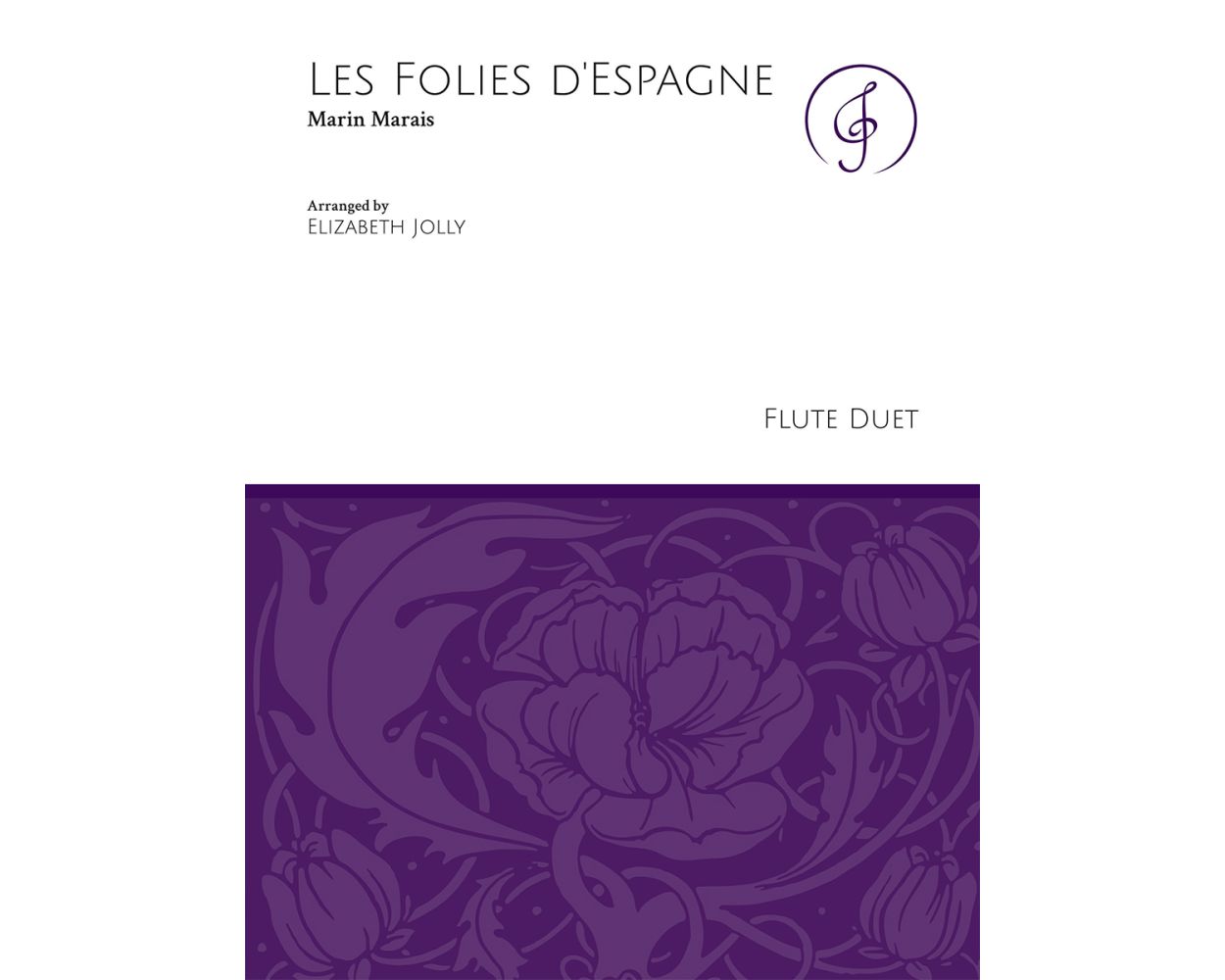
A master of the French Baroque, Marin Marais was one of the most celebrated viol players and composers of his time. Les Folies d’Espagne is one of his most enduring works, a virtuosic set of variations on the popular Iberian ground bass known as La Folia. This was a favorite theme among Baroque composers, characterized by its hypnotic chord progression and rhythmic energy. In Marais’ hands, the theme becomes the foundation for 32 inventive and increasingly complex variations. Originally written for viola da gamba and continuo, this piece has become a staple of the unaccompanied flute repertoire. In this flute duet arrangement, the C flute plays the more virtuosic solo part while the alto flute provides the accompaniment of the continuo part.
A master of the French Baroque, Marin Marais was one of the most celebrated viol players and composers of his time. Les Folies d’Espagne is one of his most enduring works, a virtuosic set of variations on the popular Iberian ground bass known as La Folia. This was a favorite theme among Baroque composers, characterized by its hypnotic chord progression and rhythmic energy. In Marais’ hands, the theme becomes the foundation for 32 inventive and increasingly complex variations. Originally written for viola da gamba and continuo, this piece has become a staple of the unaccompanied flute repertoire. In this flute duet arrangement, the C flute plays the more virtuosic solo part while the alto flute provides the accompaniment of the continuo part.
A master of the French Baroque, Marin Marais was one of the most celebrated viol players and composers of his time. Les Folies d’Espagne is one of his most enduring works, a virtuosic set of variations on the popular Iberian ground bass known as La Folia. This was a favorite theme among Baroque composers, characterized by its hypnotic chord progression and rhythmic energy. In Marais’ hands, the theme becomes the foundation for 32 inventive and increasingly complex variations. Originally written for viola da gamba and continuo, this piece has become a staple of the unaccompanied flute repertoire. In this flute duet arrangement, the C flute plays the more virtuosic solo part while the alto flute provides the accompaniment of the continuo part.