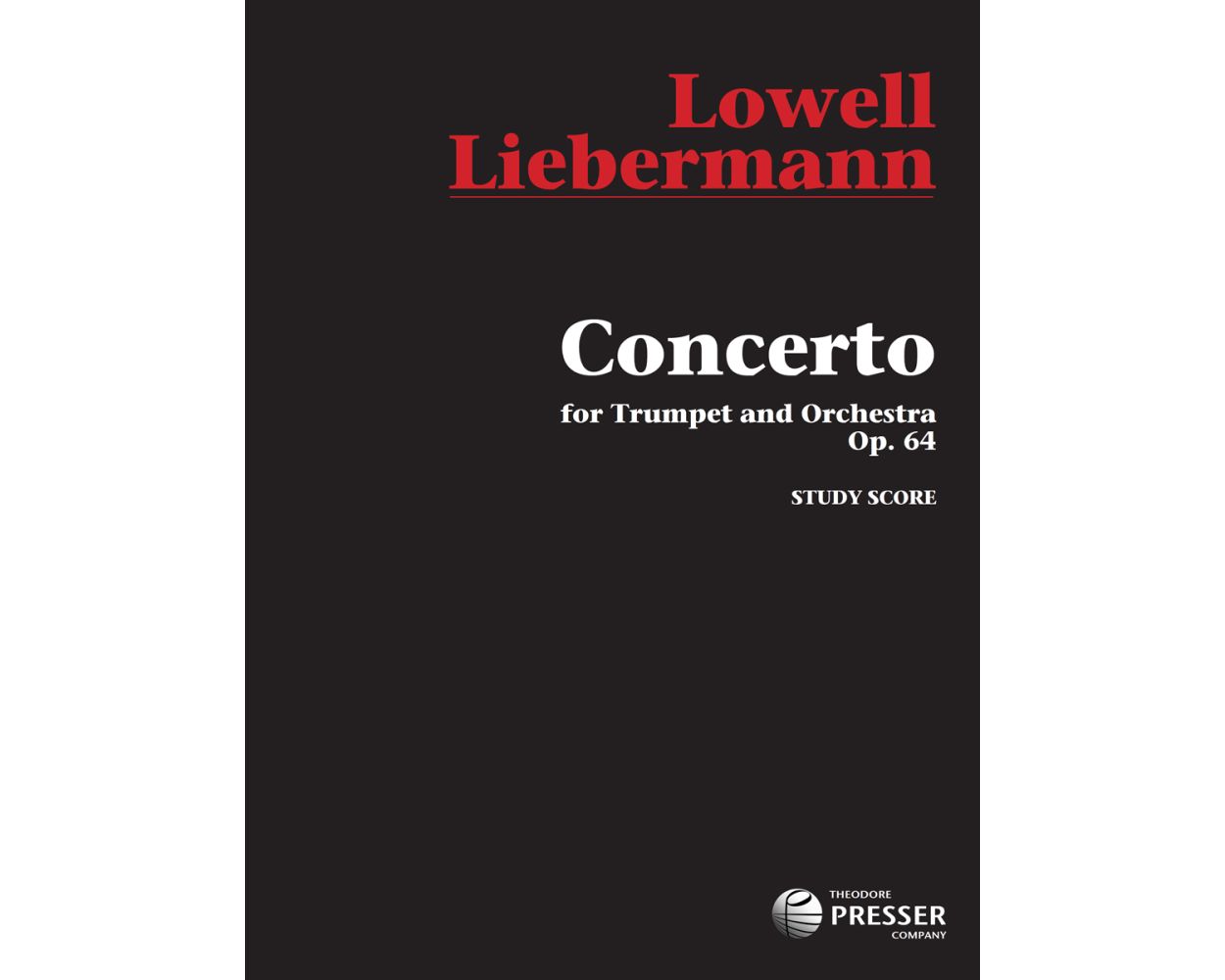
Concerto
For Trumpet and Orchestra
$48.00
Custom Print
Allow 4-5 days
Rental
Liebermann's Concerto for Trumpet and Orchestra, Op. 64 was premiered in 2000 by the New York Philharmonic at Avery Fisher Hall with Philip Smith on trumpet, conducted by Kurt Masur. It was commissioned by John Marstellar and Helen Marsteller Treutel in memory of Julliard trumpet instructor Edward Treutel. Performance materials are available on rental.
Orchestral score and parts available on rental from the publisher.
Liebermann's Concerto for Trumpet and Orchestra, Op. 64 was premiered in 2000 by the New York Philharmonic at Avery Fisher Hall with Philip Smith on trumpet, conducted by Kurt Masur. It was commissioned by John Marstellar and Helen Marsteller Treutel in memory of Julliard trumpet instructor Edward Treutel. Performance materials are available on rental.
I was very eager to write this concerto, because, strange to say, I had never before written for any brass instruments in solo or chamber music. Of course, I use the brasses in the context of orchestral music, so I was quite familiar with the technical exigencies of writing for the trumpet. I began the process by studying and listening to the existing ?basic repertoire? of trumpet concertos, to familiarize myself with what had been done before, to get the sound in my ear. One of the things that became apparent is that there really aren?t very many truly substantial trumpet concertos that get played. I knew that I didn?t want to write a jazz-inflected piece: jazz is simply not my voice. But I was strongly drawn to the idea of exploring the trumpet?s lyrical mode, which you don?t hear too often. On the whole, this is a generally lyrical piece?perhaps unusual among trumpet concertos.
Although I have employed different structural plans in some of my other concertos, here I stick with the standard three-movement layout for a concerto. It?s a formula whose contrast has proven effective over time; if it?s not broken, don?t fix it. The instrumentation requires a standard full symphony orchestra. I call for a percussion section that looks pretty rich on paper, but I like to use the percussion instruments rather sparingly, for occasional highlights of color. Except for the bells in the second movement and for some timpani writing, the percussion players are not thrust into the spotlight as soloists.
I wrote this concerto while doing a residency at the Rockefeller Foundation in Ballagio. I spent a month there in May of 1999 in a stone studio overlooking Lake Como?not so terrible! There was a little 11-th century church at the base of the hill, and every hour the church bells would ring in E-flat. This crept into the second movement, where bells in E-flat, imitating church bells, serve as a reminder of that sonic landscape.
The final movement is a sort of slapstick comedy. There I?ve worked in lots of quotations, musical puns, and certain harmonic detours that can prove amusing. I included a quotation from "The Carnival of Venice" because I noticed that it was alarmingly close to the first theme of the opening movement. Listening to the first movement, one might not notice that this is the case, because the melody gets very different harmonic support there. But I realized that the outline of the theme is similar, and so I made a little adjustment and presented a quotation of the famous tune in the finale; of course, trumpeters have often been known to play variations on "The Carnival of Venice." There?s a Shostakovich reference in the last movement, too, and also a parodistic section that sounds kind of like the Pachelbel canon gone awry. The finale has quickly shifting gears: the music is forever starting one way but then veering off into something unexpected.