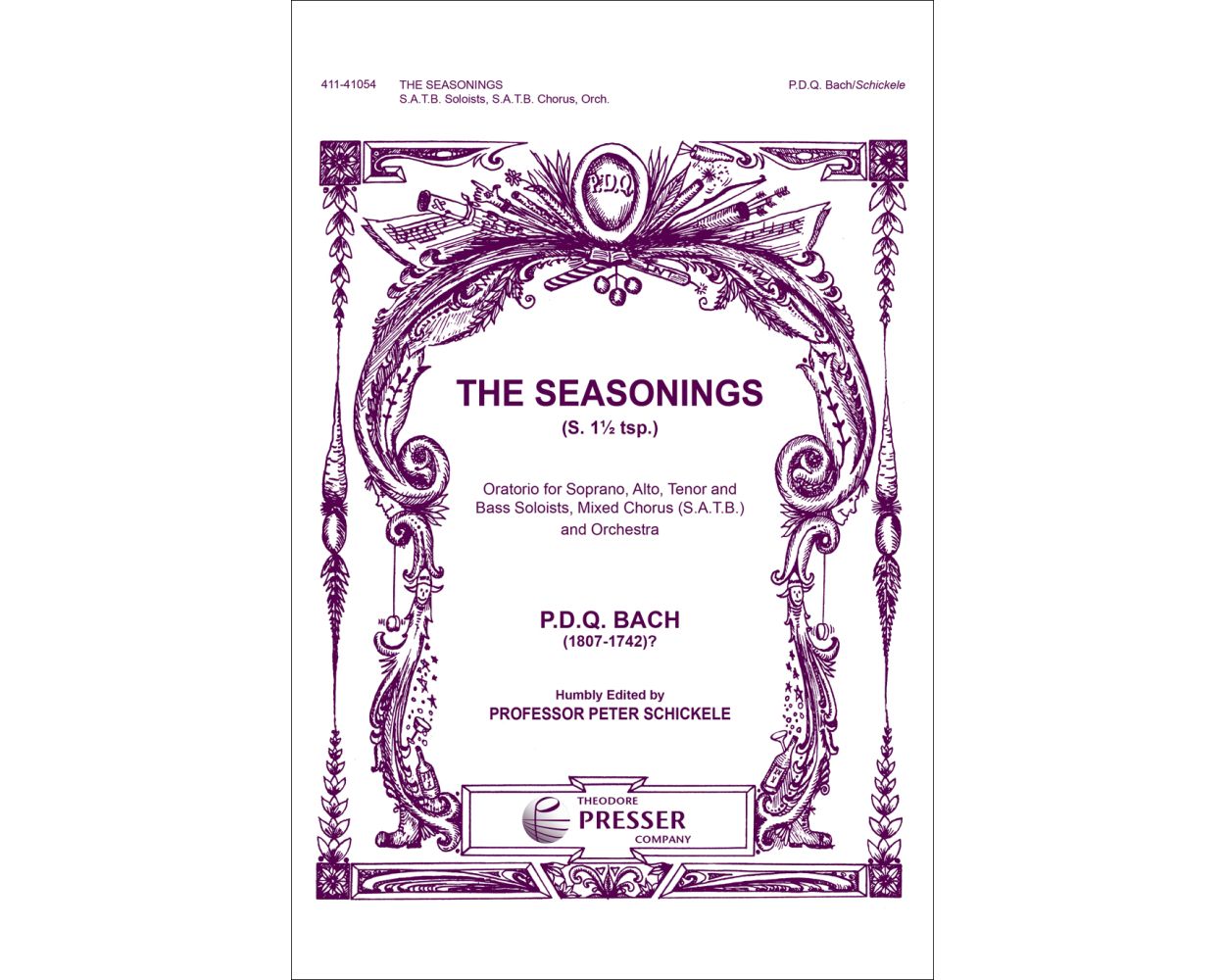
The Seasonings (S. 1½ Tsp.)
Oratorio for Soprano, Alto, Tenor and Bass Soloists. Mixed Chorus (SATB) and Orchestra
$10.99
Rental
Custom Print
Allow 4-5 days
The unearthing of the grand oratorio, The Seasonings, was especially exciting, since it proved beyond a doubt that P.D.Q.'s inabilities ;were not limited to the smaller forms; every measure of this monumental work is infected with the same lofty intentions which permeate the cantata Iphigenia in Brooklyn and other shorter pieces, and the carrying out of these intentions is equally disappointing. The road to musicians? Hell must be paved with P.D.Q. Bach compositions.
His instrumentation, however, is always interesting; in The Seasonings, he employs a lurid assembly of instruments which, in addition to the usual trumpets, timpani, and strings, includes a push-button chord organ, two slide whistles, two kazoos (the instruments themselves are modern, but for the sake of authenticity they are equipped with original 18th century tissue paper), a shower hose in D, a tromboon (this instrument is a hybrid - that's the nicer word - constructed from parts of a bassoon and a trombone; it has all the disadvantages of both), a windbreaker and a slide wind-breaker (perhaps the less said about these the better; they consist of tuned mailing tubes, and are sometimes referred to in old treatises as "mailing tubas") and, interestingly enough, a foghorn. I don't know of any other piece, intended for performance on the land, that uses a foghorn.
The Seasonings is, as far as is known, the only oratorio written by P.D.Q. Bach, and we must thank God for small favors. The oratorio was written during the last of the composer’s three creative periods—Contrition—when he gave up many, though not all, of the extravagance of the Soused Period, and the characteristically incompetent characteristics of the Initial Plunge. The work was first published in Liverpool by Jonathan “Boozy” Hawkes, who has been of one P.D.Q.’s many drinking companions. Since the original manuscript has never been found, and since the first published edition was already in English, with no credit given for the liberetto, we can only speculate about the authorship of the text; or, of course, we can simply not think about it at all.
The Seasonings is, as far as is known, the only oratorio written by P.D.Q. Bach, and we must thank God for small favors. The oratorio was written during the last of the composer’s three creative periods—Contrition—when he gave up many, though not all, of the extravagance of the Soused Period, and the characteristically incompetent characteristics of the Initial Plunge. The work was first published in Liverpool by Jonathan “Boozy” Hawkes, who has been of one P.D.Q.’s many drinking companions. Since the original manuscript has never been found, and since the first published edition was already in English, with no credit given for the liberetto, we can only speculate about the authorship of the text; or, of course, we can simply not think about it at all.
The Seasonings is, as far as is known, the only oratorio written by P.D.Q. Bach, and we must thank God for small favors. The oratorio was written during the last of the composer’s three creative periods—Contrition—when he gave up many, though not all, of the extravagance of the Soused Period, and the characteristically incompetent characteristics of the Initial Plunge. The work was first published in Liverpool by Jonathan “Boozy” Hawkes, who has been of one P.D.Q.’s many drinking companions. Since the original manuscript has never been found, and since the first published edition was already in English, with no credit given for the liberetto, we can only speculate about the authorship of the text; or, of course, we can simply not think about it at all.